


(Editors Note: This is a guest post from my friend Andrew Warfield. Seminarians in Boston and New York peaked in 1953; in Galveston-Houston, in 1959. The collapse we assign to Vatican II was underway a decade before it opened. Andrew Warfield has written a well-researched diagnosis, and while I don’t necessarily agree with everything in the essay, the essay is well worth the time it takes to read.)
There is No Vocations Crisis
All across the country parishes are merging, Masses are split between different times at multiple sites, vocations directors are expressing alarm, bishops are restructuring diocesan ministries, and there are thousands of parishes without a resident priest.1 Every fact in that list is true, but the story that we tell about them isn’t.
Today, the most conservative ratio of practicing laity to active diocesan priests is roughly 860.2 This is a crowd easily served by two Sunday Masses of 430, with canon law providing for bination.3 How are 860 practicing Catholics per active priest too many?
The ratio is more than sufficient: we have more priests per practicing Catholic today than at the statistical peak of Catholicism in the United States.4 And that doesn’t even tell the whole story. Today’s numbers are not analogous to the peak’s. Then, nearly every priest alive was active, because priestly retirement only became common after the Council.5 Today, a third of diocesan priests are retired, and while some are infirm, many still say Mass and hear confessions.6 If we count every living priest, today’s ratio of practicing laity to total priests is better than the Golden Age itself.7
And the priests are not counting alone. There are 18,425 permanent deacons,8 and nearly 40,000 paid lay ministers who do the catechesis, youth work, and pastoral care that once fell to priests and sisters;9 in 1970 permanent deacons did not exist and there were not yet enough lay ministers for them to be tracked. There have never been more ordained men relative to practicing Catholics.10 So where is the panic coming from?
The Church is in crisis, but the framing is all wrong. The ratios hold not because the Church is healthy, but because the number of priests and the number of practicing laity have declined together. One number has not collapsed: the number of parishes. The endpoints of 1970 and today hide a hump in the interim decades from a building boom as the Church chased the laity to the suburbs, followed by closures that erased the boom,11 even as the nominal Catholic population grew by more than eighteen million.12 Practicing laity has fallen by more than half, the parish footprint has decreased by about a tenth, and so the average practicing congregation has been cut in half.13 The priesthood can easily serve the practicing Catholic laity, but it can’t staff 16,125 parishes. The stagnant parish footprint and decreasing number of priests mean that there are more parishes than active diocesan priests,14 and the number of parishes without a resident priest has grown sevenfold. It is this Detroitification of the Catholic Church that has conjured up the narrative of the vocations crisis.
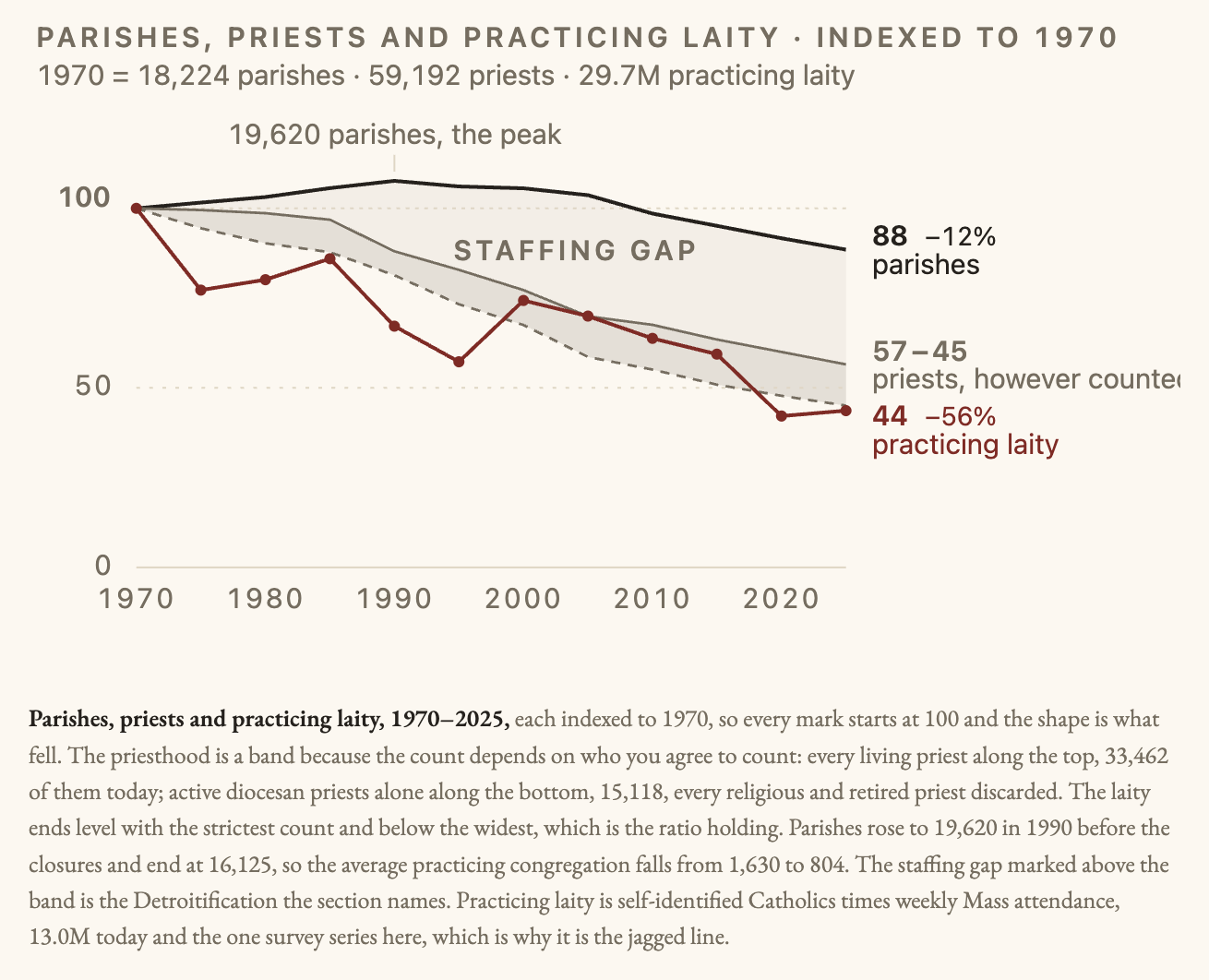
The collapse of the laity and the priesthood are not two separate crises; one is downstream of the other. Vocations are formed from the practicing laity, so a smaller laity will mean fewer priests. It’s no coincidence that ordinations have fallen almost exactly as fast as the practicing population. Measured against the nominal Catholic population, vocations have collapsed. Measured against the Catholics who still practice, they never did.15 The vocations pipeline is not broken: its source is dying. A priestly vocation is a call that a young man ordinarily answers only after a certain kind of formation, when he has seen the care that the priest can give to others, when he has been surrounded by those who take vocational questions seriously, and when he knows what it means for the priest to stand at the altar and say, “This is my Body” and “This is the chalice of my Blood”. A priestly vocation and a practicing Catholic are formed in a certain kind of place.
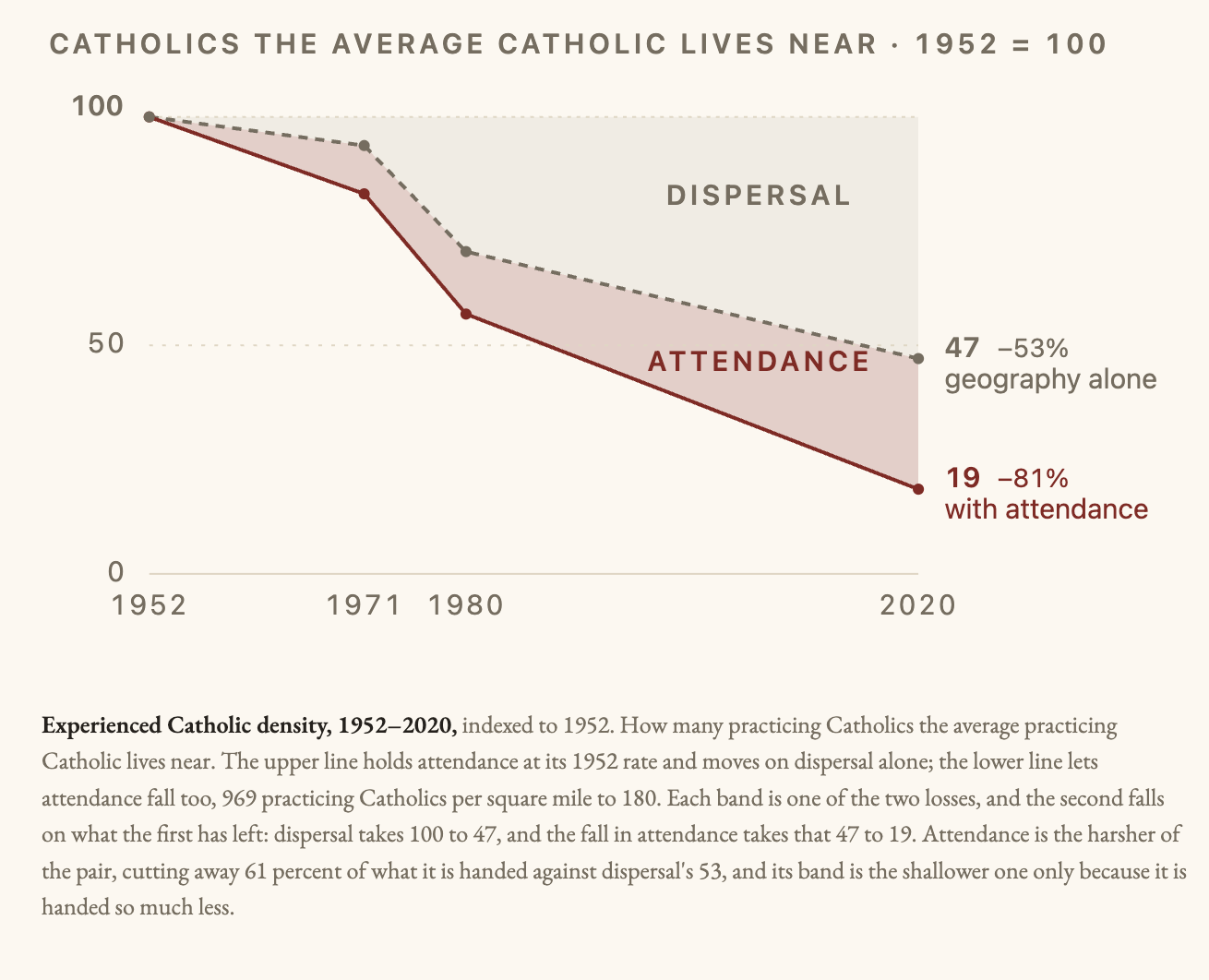
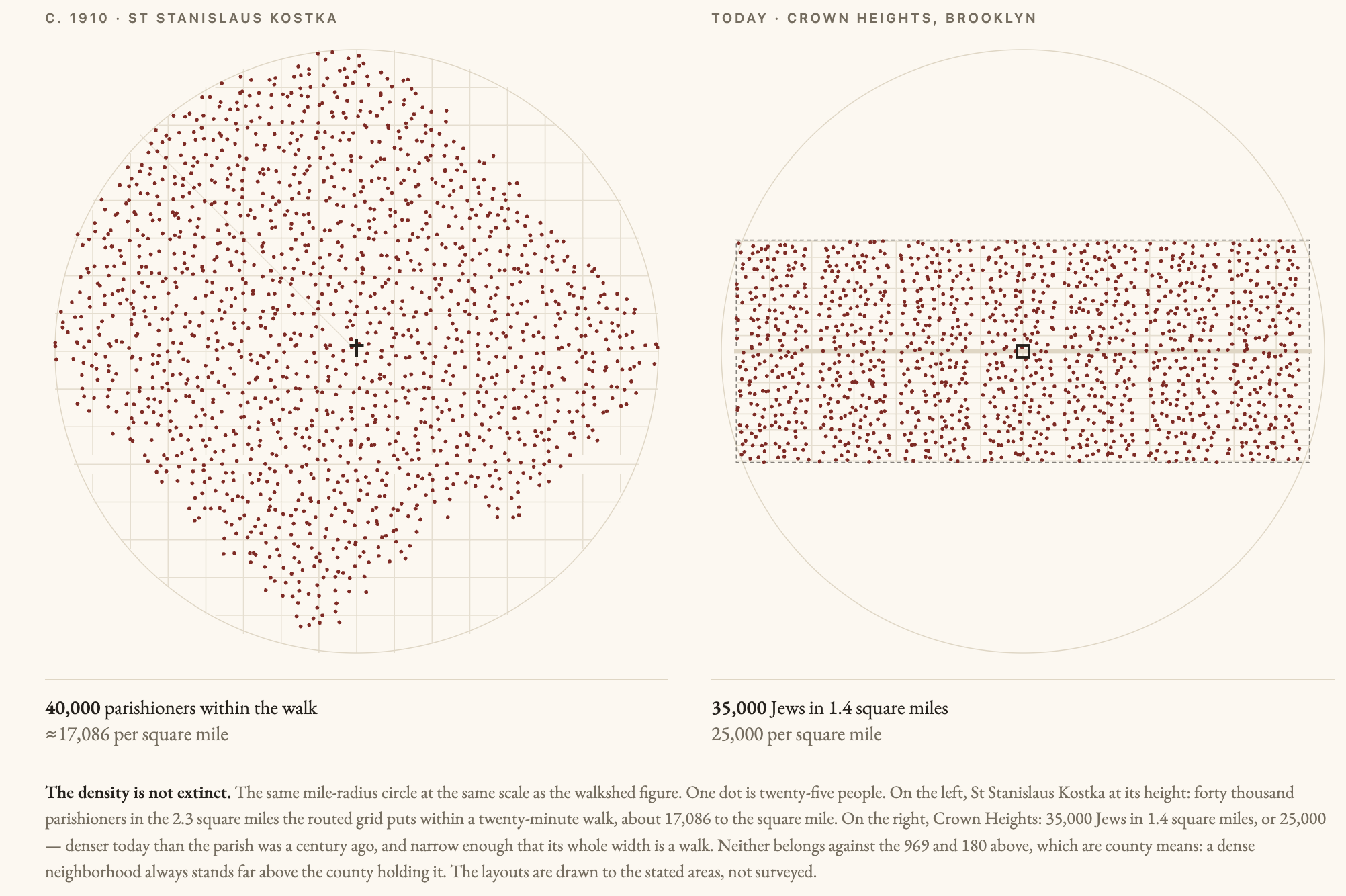
During its late-19th and early-20th century heyday, St Stanislaus Kostka in Chicago had 40,000 parishioners. To have a ratio equivalent to today’s diocesan ratios, and counting only half of those parishioners as practicing, St Stan’s would have needed roughly 23 priests; a ludicrous number that no American parish has ever had.16 St Stan’s pastoral model, where a single priest served a huge number of laity, was enabled by proximity; nearly all of St Stan’s poor Polish laity lived within a 20-minute walk of the parish. This is what the urban American parish looked like before it was broken up. Holding attendance constant, experienced Catholic density, a measure of how many Catholics the average Catholic lives near, has dropped by 53% since the early 1950s. When including the fall in attendance, experienced practicing density has dropped by 81%. That’s a decrease from 969 practicing Catholic neighbors per square mile to 180.17 If a mile walk takes roughly 20 minutes, in the early 50s the average practicing Catholic could easily walk to something on the order of 2000 other practicing Catholics. Today, that number is about 400.18 Integration is built from proximity, and experienced density is how its loss can be measured. If we had the same level of density as in the early 1950s, our priests could easily serve all of the practicing laity. But the question was never about the priests. It was about the laity: when they stopped practicing, and when they began to scatter.
Decline Started Before the Council
The standard traditionalist narrative about the decline of the Catholic Church in the West goes something like this:
The Second Vatican Council, or, generously, those who bore its banner, ushered in reforms that stripped the liturgy of its sacred nature and diluted the Church’s traditional teachings to accommodate the modern world. These reforms led to a lack of reverence for the Eucharist, catechetical confusion, a loss of Catholic identity, and hence a sudden collapse in the years after the Council’s implementation. Given that the Council was shared by the entire West, and that the Church collapsed across the entire West, it is the only thing that can explain the magnitude of collapse all at the same time.
This is a valiant sense-making effort, but still wrong. By 1961 the rate of diocesan ordinations per million Catholics had already fallen by 28% in seven major European dioceses compared to the 1950s average. But ordinations are the product of years of formation, and answering the call to a priestly vocation in the first place requires a formation that inculcates a supernatural mindset. As such, ordinations are a lagging indicator of decline: as goes the ordination class of today, so went the laity nearly a decade ago. Therefore, looking at seminarian numbers can help us pinpoint when exactly the decline started. In the Archdioceses of Boston and New York seminarians peaked in 1953 and declined thereafter. The Galveston-Houston diocese hit an all-time high of 100 seminarians in 1959 that has not yet been surpassed even while the see’s Catholic population has increased by nearly five times since then. Four of seven major European dioceses had fewer seminarians in 1959 than in 1951.19 The decline in seminarians preceded the Council by a decade. This raises the question: what broke the Western vocations pipeline in the 1950s?
In Bryan Wilson’s 1966 work Religion in Secular Society he argues that secularization is linked to the decline of close knit small scale community and the shift towards national scale societies. Sabino Acquaviva’s 1961 The Decline of the Sacred in Industrial Society documented the death of traditional rural Catholicism in Italy. Jean-Charles Falardeau documented the social damage that migration had done to the church in Quebec as early as 1952. Gabriel Le Bras and Fernand Boulard studied French Catholicism before, during, and after the decline and concluded that it was due to the death of the integrated rural parish and Catholic school. The mechanism of community decline causing secularization was so widely accepted among scholars that Peter Berger attempted to move from concrete history to theoretical framework in The Sacred Canopy. This was the dominant view of sociologists of religion before anyone could see the effects of the Second Vatican Council.
The liturgical havoc, the catechetical chaos, and the mass exodus of priests prompted by the Council added a layer of institutional disorientation on top of the structural implosion already underway. The acceleration of the decline after 1965 is real, and cannot be explained solely by the destruction of the integrated walkable communities at the center of Catholic life. Even so, the Council was but the gasoline to a fire that had raged under the floorboards for decades. We have spent sixty years litigating that gasoline, but it’s time we reckoned with the fire.
It Happened Everywhere
Nearly every Western country experienced mass spatial migrations that destroyed Catholic communities and traditional ways of living roughly between 1950 and 1975. In the United States this took the form of a flight to a specific suburban style with its own unique pathologies, but the particulars differed by country. What was consistent was the spatial disruption that destroyed community, and the lack of integration in the newly adopted form. That’s the fire.
Prior to the mid 20th century French Catholicism was primarily rural and agrarian. These rooted communities were centered around their local parish and Catholic school. In the late 40s the French started to flee the countryside for the cities. This migration was so sudden and violent that in 1964 the Cardinal of Paris affirmed the construction of 142 new churches in the suburbs ringing Paris.20 The need for sacramental and communal infrastructure in these new suburbs was so great that the Archdiocese dropped tent churches, inflatable churches, and pre-built parish gathering spaces right into high-rise suburban public housing projects.21 One such suburb, Sarcelles, saw an over 500% population increase of ~43,000 people between 1954 and 1968, yet two of its churches closed in the 1970s.22 In 1975 the diocese of Evry in the southern ring of Paris indefinitely postponed building a new church, thinking it would be “useless, even counterproductive”.23
The Spanish economic miracle from the mid 1950s to the early 70s prompted a mass movement to the cities. In 1960 there were over 8,000 seminarians in Spain, but by 1970 that number had fallen to just under 5,000.24 Pablo Pérez López from the University of Navarra summed it up: “the decline in the knowledge and practice of the Christian faith responded above all to a change in lifestyles… It was a mutation that first affected the place where people lived: Spaniards emigrated massively to the cities in those years.”25
In the 1960s Quebec’s Quiet Revolution saw Catholicism nearly wiped out. In the span of a decade Mass attendance, vocations, and the fertility rate crashed while schools and hospitals were seized from the Church by the state. Traditionally, the collapse of Quebecois Catholicism is explained by precisely this institutional seizure. Quebec had two waves of internal migration: one in the late 19th and early 20th century to the cities, and then one in the 1950s and on to the suburbs. What set Quebec apart is that the church was able to keep up with the urban migration, and gradually subdivided parish territories to accommodate the growing urban population. Even while practice remained high, sociologist Jean-Charles Falardeau documented that the parish’s domination over community life was weakening as compared to life in the rural village.26 Then in the 1950s, American style suburbanization and the steady fall of population density in the central city began. In 1960 an all-out collapse started as the flight to the suburbs intensified and the Church was unable to reconstitute communal life. The two migrations are the argument in miniature: where the Church could reconstitute proximity, practice held, and where it could not, practice collapsed. The suburban dispersal was the fire; the government’s seizure of schools and hospitals was the gasoline. Quebecois Catholicism never recovered.
Ireland is the control case. With a Mass attendance rate of roughly 90% in 1961 and 91% in 1975, Irish Mass attendance was completely unfazed by the Second Vatican Council. In Moral Monopoly, Tom Inglis cites the breakdown of the integrated parish-school-community life as a cause of the death of the country’s faith practice. In the 1990s Ireland had its own suburbanization and Catholic practice collapsed within a generation; the Church could not face the shock of the abuse crisis without the integrated communities that held the faithful together. Granted that Ireland experienced substantial economic growth, suburbanization, and the full legalization of birth control within 10 years, the collapse cannot be pinned solely on suburbanization.27 What is beyond doubt is that it was not the Second Vatican Council.
The same story played out in Germany through the breakup of the Katholisches Milieu, with the Ontzuiling of the Netherlands, Italy’s mass migrations during the miracolo economico, and the UK’s slum clearances. 28 What the new forms had in common was a dis-integrated environment that formed their residents in ways that are contrary to the practice of the Catholic faith. This destruction of integrated community was not the sufficient cause of the collapse, but the necessary condition for the other shocks of the 20th century to be efficacious.
What the Ghetto Was
We use the word “ghetto” to describe the bad part of town, the place you don’t want to go, where you won’t be safe. But for the American Catholic of the urban immigrant parish it was the place where you couldn’t walk outside without seeing a priest, religious, or the neighbors who would one day bury you. The territorial community of the parish given by canon law and the spatially dense community around it enabled a life saturated by the Church. The average day began with church bells, seeing fellow parishioners at work, pausing for the noon Angelus bells, striking up a conversation with another neighbor who was also a parishioner on the way to your front door, having a family dinner with a rosary afterwards, and then heading to the Sängerbund for recreation. Every time you walked by your parish, which was often, you would cross yourself in reverence of the Eucharist inside, and on Corpus Christi would process through the neighborhood proclaiming His real presence to all. Whether it was walking by a statue of Mary in a window or helping your neighbor shovel their sidewalk, Christ was everywhere. In the ethnic ghetto even the lax families showed up to church on Sunday because people expected them to be there, and they got their kids baptized and sent them to the local Catholic school because it’s just what you did. Catholicism was not just a set of thoughts, but an entire way of life.29
It’s true that this world had real ugliness too. Catholics of different ethnicities and races had deep hatreds of each other and would refuse to integrate their communities by enforcing their parish boundaries with violence. The neighborhood was sacred because its life revolved around the parish and its rituals. The violent defense of the neighborhood from the encroachment of out groups was the perversion of that sacredness. While the racial prejudice was contingent on the time, it’s inevitable that any intimate place-based community will exhibit some degree of insularity.
The duties and obligations that came with this way of life also led to individual constraints that today we might find unacceptable. But it was these obligations and duties that built your life; the funeral you couldn’t miss and the feast day celebrations you had to help put on became the funeral where you would be mourned and the feast day celebrations that were put on for you. Living in the ethnic ghetto was to experience a unified fabric where every facet of your life was part of a larger whole that you were immersed in every time you stepped outside.30
Suburbia’s Native Religion
Every Sunday the 3,000-car parking lot of the nondenominational megachurch near your house overflows with people from 30 miles around. The church has three worship services, and a bookstore coffee shop that’s only open on Sundays. People spend an hour or three there at most. This is the epitome of the American Christian life: a sealed compartment where one can come and go at will, separated from every other part of life. Though this is the stereotypical form of American Christianity, its roots run much deeper.
In the 1790s a group of socially and economically elite evangelical Church of England adherents in the UK began to coalesce into a movement. This evangelical movement’s morality went on to reform the British Empire and define the Victorian Age; among its members were William Wilberforce, who spearheaded the movement to abolish the slave trade, Charles Grant, who chaired the directors of the East India Company, and Lord Teignmouth, who governed India. Despite their social and political action culminating in the abolition of the slave trade, they’re known by the place where they lived. Clapham was a semi-rural village within a short carriage commute to London, and most importantly, far away from the vices of city life. This is why the Clapham Sect chose it as the site for an intentional religious community built around single family homes where the family and the individual were the primary units of piety. This place, where spatial boundaries enforced the strict delineation of work, home, commerce, and church, was the first suburb.31
As an intentional religious community built by evangelicals, Clapham reflected their particular understanding of anthropology and ecclesiology. The Clapham Sect believed in a moment of experience in which the individual receives an assurance of being saved; William Wilberforce dated his to 1785 or 1786.32 Evangelicals think this is an unmediated moment of grace between Christ and the individual’s soul triggered by faith alone. In their view, the church is not the universal sacrament of salvation,33 but merely a body where those who know they’re saved gather. A salvation that is atomic, individual, and completely interior can be moved from any built environment and mode of life to another. It requires nothing other than the individual’s certainty. This is anathema to the Catholic. The Church teaches that salvation is uncertain and progressive; that rather than possessing salvation, one hopes for it.34 By Catholic teaching, without another person the ordinary means of salvation are closed. Another person baptizes you, and hears your confessions, the Eucharist is consecrated by another and received in community, and Holy Orders is passed down by the hands of a bishop whose lineage flows back to the apostles. The Catholic life well lived requires proximate access to the sacraments, and to the community that you receive them from.
The Clapham model of single family homes separating the life of work, home, and church was replicated writ large in the UK and then exported across the Atlantic to the United States. Philadelphia was home to one of the country’s first railroad suburbs, with this becoming the suburb’s stereotypical form.35 This suburban lifestyle had become the normative lifestyle for the American upper class by the early 20th century. After World War II, the federal government mass produced the suburb through the FHA, the GI Bill, and the interstate highway system in a housing construction boom the likes of which the country hasn’t seen since.36 What Clapham had chosen, federal policy made the default. In pursuit of a government subsidized middle class prosperity, Catholics moved into these suburbs en masse and traded the Angelus bell for the 30-minute commute to Mass.
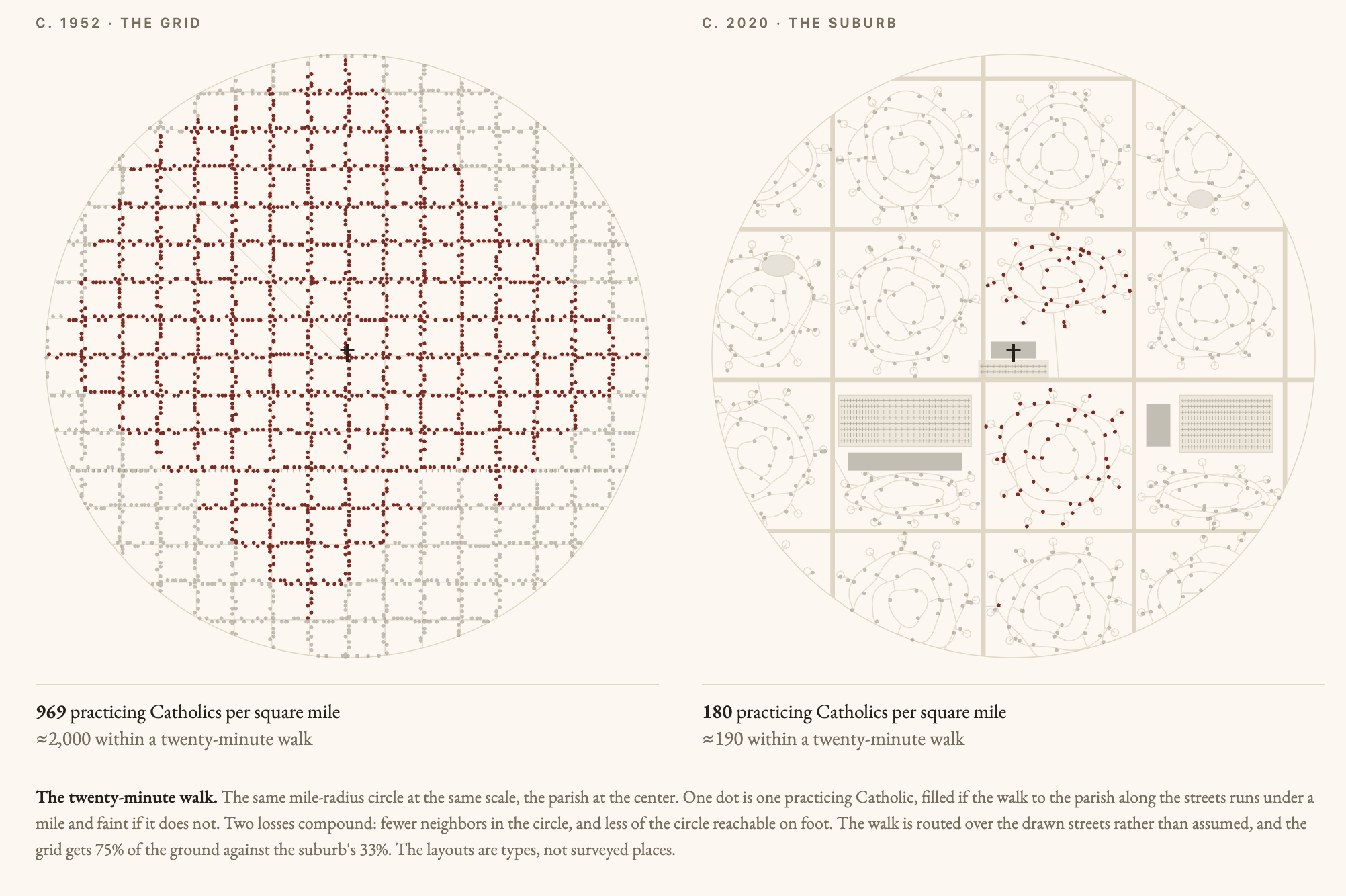
The suburb’s destruction of the faith community removes the context in which faith makes sense and is continuously confirmed. In The Sacred Canopy Peter Berger calls this communal reinforcement the plausibility structure, and documents its erosion as a force of secularization.37 The plausibility structure’s communal reinforcement does not make faith any more true; it makes it obvious. Faith doesn’t fail by refutation, but by the erosion of the community that makes up the plausibility structure; faith turns from something that is obvious into a choice.
The evangelical anthropology built into the suburb also dissolves the embodied nature of the faith. For the Catholic, you have to go to Mass, and you have to be present in front of the priest for the absolution to ontologically change your soul’s relationship with God. But in the suburb the Catholic faith is forced to survive in the only way that it can: interior assent. In A Secular Age Charles Taylor describes this lack of embodied practice as excarnation. Suburban Catholicism is excarnated Catholicism: the inversion of what Christ did for us. In the same stroke that suburbia forces faith into interior assent it erodes the plausibility structure that sustains that interior assent. Embodied practice is its own evidence: the man kneeling beside you simultaneously adores God and shows you that this is real. Faith and its expression are a single act, and the Church has never separated them. The evangelical sees belief as complete in itself and demotes the act to mere proof: a second act to be performed afterwards or not at all. The suburb builds that distinction into your way of life: the suburb is where the second act stops being ordinary.
The destruction of the plausibility structure and the excarnation dispose their residents to the formative end state of suburbia: what Taylor calls the buffered self.38 The buffered self is the state of being in which an individual perceives meaning as coming from within themselves rather than from the things of the world outside of them. It is the sealed compartment of the suburban home and private car internalized by the individual through decades of the form catechizing its residents. In the suburb the American Catholic effectively becomes Protestant while retaining the Catholic label.
It’s no wonder that Catholicism in the post-war United States collapsed while evangelicalism thrived; Protestantism had a suburban-adapted form in evangelicalism that Catholicism didn’t. Catholicism will be outcompeted when it operates inside a built environment that is evangelical anthropology made manifest. Clapham was a tight-knit intentional and walkable religious community that sowed the seeds for the optionality that the suburban megachurch has reaped. The logic of the buffered self is inherently unstable; once you choose your church, what’s to stop you from choosing no church at all? The freedom to choose everything has eroded the very foundation of faith: the sense of the givenness of everyday life that comes from community and the embodied practice of its belief.
There is a remnant of devout suburban Catholics who have attempted to return to the integrated life of faith that sustained those before us. They’ve built robust homeschooling co-ops and classical schools, clustered around good parishes, and established networks of mutual aid that constitute small recoveries. These Catholics have rebuilt by brute force of will the integrated life of faith inside of a form that destroys its very nature. If Catholicism could live on interior assent alone, they would not have needed to build anything to live an intense life of faith. A true counterexample would be the intensely faithful Catholic family thriving in suburbia’s dispersion with no community and no institutions, but these families are astonishingly rare. What the remnant achieves by heroism, proximity once made ordinary.
The word heresy comes from the Greek word hairesis, meaning “choice”. If modernity democratized heresy, then the suburb is its architecture. Every individual has their choice of grocery store, their choice of parish, their preferred faction of Catholicism, or the choice not to be Catholic at all. By making choice mandatory, the suburb makes heretics of us all.39
Dis-integration
The Church sees original sin as a privation of original justice with dis-integration—a departure from the original integritas of the soul before the fall—as a consequence. It manifests as dis-integration between God and the soul, dis-integration between the higher intellect and the passions, and dis-integration between peoples. Sanctification then is the gradual re-integration that takes place in this life that foreshadows the complete integration of the life to come. Just so, suburbia has a spatial liturgy of dis-integration where all things are separate from one another. There is a compartment for work, a compartment for family, a compartment for community, a compartment for shopping, a compartment for education, and a compartment for religion.
This spatially manifested dis-integration leads to the privation of the conditions under which people are usually disposed to receive grace. Grace is God’s alone, but the built form can dispose us to cooperate with it. A suburban life is one where the altars and the priests remain, but the ecosystem around them has disappeared. In Catholicism, Henri de Lubac argues that salvation is intrinsically social. To demonstrate this he recovers the positive meaning of “there is no salvation outside the Church”, by pointing out that the Church is the body of believers and that it is only through this body of believers that you can be saved. God is the logos, the ground for all meaning and intelligibility. As the logos, He is the transcendent source of the social fabric that binds people together and allows them to understand each other. This is why sin is an offense against both neighbor and God; He yearns for us by connecting us to each other.
Catholicism is a faith that sees the ordinary means of the reception of grace as being mediated through the other, the particular. The Son assumed flesh in the world in time and place so that we might contact the universal through His particularity. Romano Guardini argues that modern technology abstracts us away from particularity and so starves us of the universal.40 This is what the suburb is. It is an abstraction that uses zoning and land use ordinances to ban the mixed uses that create the conditions for encounter and leaves us little to love. The suburb deprives us of the given particulars of the other, our neighbors, and so leaves us famished for the universal. This is what we mean when we call the suburb “soulless”.
Lex orandi, lex credendi, lex vivendi. Right prayer leads to right belief, which leads to right living. Generally attributed to Prosper of Aquitaine, the first couplet of this phrase was always about communal prayer; the rule of prayer he is referring to is “the sacraments of the priestly supplications”.41 The integrated life of faith exemplified in the American context by the ethnic ghetto created the conditions for a lex orandi that sustained the community’s lex credendi, and led to an integrated lex vivendi. The suburb is not the absence of a lex orandi. It is a rival one that is predicated on an intrinsically private model of salvation that forms its own lex credendi, and sustains its own lex vivendi. This lex vivendi catechizes its residents into the buffered self that is ordinarily incapable of sustaining Catholic life.
Other groups have defeated suburbia through community-binding technology. The suburban Modern Orthodox, such as those in the Five Towns just outside of Queens, must live within the eruv and observe the ban on driving on the Sabbath.42 These laws have led them to create integrated walkable communities around their synagogues that restore proximity at the cost of a very small livable area. Mormons have preserved territoriality through their strictly geographic ward system, essentially just the Catholic rule about territorial parishes but actually enforced, as well as a very demanding community life.43 As case studies in the effects of losing both territoriality and proximity we have Catholicism and Conservative Judaism. In 1950 Conservative Jews voted to lift the Sabbath ban on driving cars to synagogue, and only to synagogue, in order to preserve communal worship for those who had already moved out of walking distance.44 Since then, Conservative Judaism has seen a large decline in its share of Jewish adults, with the chancellor of the Jewish Theological Seminary calling the lifting of the ban a mistake in 2003.45 By the movement’s own later reading, the car broke the synagogue-centric Conservative Jewish community by making attendance voluntary and enabling the community’s dispersion; the Catholic parish seems to have died the same death.
A dis-integrated way of life cannot ordinarily transmit the faith to the next generation. And it doesn’t. Of the young Catholics that disaffiliate, half report leaving by 13 years old.46 A generation of children formed by conditions that are fundamentally anti-Catholic, and already gone before they can fully comprehend that it was their soul at stake.
Real Assent
In Grammar of Assent, St. John Henry Newman draws a distinction between notional and real assent. For Newman, notional assent is a purely abstract understanding in which “the mind contemplates its own creations instead of things”. On the other hand, real assent “is directed towards things, represented by the impressions which they have left on the imagination”.47 Newman saw real assent as assent made operative and therefore as a more powerful assent than the merely notional. Real assent means that Christ’s death on the cross, and the vocation to live as a beloved child of God until unity with Him in the next life, are not simply therapeutic notions, but the operative framework of an entire life. Newman uses the abolition of the slave-trade to demonstrate:
“The iniquity, for instance, of the slave-trade ought to have been acknowledged by all men from the first; it was acknowledged by many, but it needed an organized agitation, with tracts and speeches innumerable, so to affect the imagination of men as to make their acknowledgment of that iniquitousness operative.”48
The abolitionist campaigner’s real assent was made concrete through objects that made impressions on others, and these impressions disposed them to their own real assent.
While real assent makes itself concrete, it is not activism. The nun in her cell who spends her days praying for the world has the most realized assent. What distinguishes the life of the nun from the life of the excarnate believer is not the level of activity. It is the level of notionality. By destroying community, suburbia destroys the social conditions that propagate real assent to the next generation. With belief starved to the merely notional level, suburban Catholicism ordinarily does not manifest itself, and so rarely serves as a vector for the transmission of real assent.
Newman finally gives us the language we’ve been grasping for: Christendom is real assent elevated to self-sustaining culture. Just as the form of the suburb has silently catechized us towards notionality and unbelief, so will a world built for sacramentality catechize us towards the faith made real. But you can’t think yourself to a plausibility structure and internet debates aren’t embodied practice.
The political Christendom of our ancestors propagated real assent through institutions that often perpetuated themselves for generations, but in order to restore any kind of Christendom in our age we must first rebuild the social engine that created it. In every era, that engine has been embodied practice in a built environment that makes community as easy as stepping out of your front door.
Little Christendoms
During the early Church’s ascendancy the Roman emperor Julian the Apostate wrote a series of anxious letters to pagan priests about the Christian problem; pagans were losing the war of conversion. He writes:
“For when it came about that the poor were neglected and overlooked by the priests, then I think the impious Galilaeans [the name given by Julian to Christians] observed this fact and devoted themselves to philanthropy. And they have gained ascendancy in the worst of their deeds through the credit they win for such practices”.49
In Tertullian’s Apology he records how pagans responded to Christian charity:
“But it is mainly the deeds of a love so noble that lead many to put a brand upon us. See, they say, how they love one another, for themselves are animated by mutual hatred; how they are ready even to die for one another, for they themselves will sooner put to death.”50
The urban Christianity of the Roman Empire spread through the social networks of believers as they gave intense witness. Christianity grew by roughly 40% a decade as pagans encountered the special care Christians gave to women, the newborn, the poor, and those afflicted by the Antonine and Cyprianic plagues.51 Roman cities were not converted by a better argument. They were converted by the intense witness of Christian believers so completely and totally that the word that we use to refer to a polytheist, “pagan”, means “rural”.52 To be pagan was to be isolated from the intensity of Christian community and practice. Centuries after the collapse of the Western Roman Empire, the mechanism ran for a second time. The Benedictine monastery’s concentrated cell of prayer, work, education, hospitality, and stability converted the unmoored peoples left in the wake of the dead empire and gave the West the lifeline it needed to rebuild.53 The monastery was the particular mechanism of the early medieval era, but we can apply its concentration and the intensity of its practice evangelizing its environs to our own time. Concentrated Christian communities have evangelized civilizations before, and in much worse circumstances than ours.
This is being done right now. Just not by us. The Hasidim of Crown Heights live out a common vision of inter-generational community that manifests as a shared way of life in a country that is largely indifferent to them. In the early and mid-20th century Crown Heights, a Brooklyn neighborhood of about 1.4 square miles, was home to around 75,000 Jews and roughly thirty large synagogues. Most notably, the Chabad-Lubavitch movement moved their headquarters to the neighborhood in 1940. As Jews fled Crown Heights in the 1960s and 70s Rabbi Schneerson, the leader of Chabad, announced that he would not be leaving and that abandoning the old, poor, and infirm was against Jewish law. Chabad stayed in Crown Heights. Catholic priests urged their laity to stay too, but saying it was no longer enough.
Today, Crown Heights is home to 35,000 Jews, 65% of whom attend synagogue at least monthly against the metropolitan average of 23%.54 There are only around 90,000 Chabad-Lubavitch adherents in the US, but more than a third of American Jews report having interacted with them and they have been the fastest-growing Jewish movement since 1945.55 Chabad concentrates and welcomes all Jews, just as the early church concentrated and welcomed all nations to join the body of Christ. Cardinal Joseph Ratzinger thought that small communities of conviction would be essential to the Church in the modern era. As he says, “Christianity will again be characterized more by the mustard seed, where it will exist in small, seemingly insignificant groups that nonetheless live an intensive struggle against evil and bring the good into the world — that let God in”.56
The lapsed are no doubt harder to evangelize through the inoculation of having “grown up Catholic” than someone who has never had contact with the Church, but the conversions of the early church didn’t depend on the evangelized being pagan. It depended on unmet human needs: loneliness, lack of intimacy, poverty, and the search for meaning. The social conditions of the suburb have created the glut of unmet human needs that we will respond to. Like the Christians of the early Church and the Benedictines of the early Middle Ages we must concentrate in order to make our way of life visible and joinable. One family in a subdivision is invisible, but a neighborhood living their faith together is magnetic. Concentration is not withdrawal. It is how we start making converts again.57
I have started to refer to the inter-generational community of intense practice as a Little Christendom. I have no blueprint or Twelve-step program for building a Little Christendom, and creating such a program might be impossible: every community may be too particular. If it could be made, it could only come from the lived experience of having built the community already. What I do know are the principles that the blueprints will have to build off of. I also know that the social community must come first. It is what will make the very soul of our society Christian, and make any political resolution operative.58
Concentration
In order to sustain a rich community life that inter-generationally transmits real assent and shows the witness of an intense Christian practice to the world we will have to concentrate. We will have to live close to one another in environments that enable that proximity. Ordinarily this is the parish, but it could also be a monastery.
Re-integration
We must seek places that can sustain an integrated social, work, educational, and faith life. Concretely, this means that the manner of our concentration must destroy the thirty-minute commute to Mass, throw out the liturgy of the school pickup and youth extracurricular ferrying, and kill the hour and a half long commute to work.
Bindingness
We will have to build institutions that make staying easier than leaving. Mormons have the ward system, while the Orthodox have the eruv, and the inability to drive cars on the Sabbath. Concentration and integration make staying pleasant, but bindingness makes leaving cost something. Obvious Catholic binding technologies include substantively Catholic schools, homeschool co-ops, and childcare networks. Other possible but high-cost options include collective land ownership, loan societies, and professional patronage networks.
I don’t suggest that the reader join a commune or radically uproot their life. I suggest marginal improvement. Most practically, building a Little Christendom means making decisions about the next job, the next move, and the next school with the aim of concentrating around a parish that will sustain an integrated life.
Recovery
For too long have the Church’s factions bickered and blamed each other for our decline while the real problem has been that we lost the conditions to ordinarily pass down the faith. The traditionalist is right that the liturgy forms the faithful, the integralist that the political order shapes its people, and the liberal that the Church must meet the marginalized. But without a durable and integrated community, the liturgy forms no one, the political order never arises, and the marginalized go unmet. Every moment we spend bickering is a moment we don’t build the future of the Church.
We have made it through the last half-century gauntlet of dysfunctional American Catholicism purely by unearned grace. We cannot save that broken model by living it more intensely. If we want to pass our faith to our children we must change. The conditions in which we live must change. We must refuse the half-truth narratives of decline. That choice will be the difference between arguing our children into every point of the faith as our environment ensures that we’re always on the back foot, versus an entire community demonstrating the truths of the faith by embedding those truths into its way of life.
The word the Greek New Testament’s commandments use for neighbor is not a word at all. It is a phrase, ὁ πλησίον, that makes the adverb for “near” into a noun to literally mean “the one being near” or “the near one”. The Vulgate preserved this meaning by rendering it as proximus, the nearest one.59 We have isolated ourselves from each other, distanced ourselves from the ordinary conditions of loving one another, and thereby lost sight of the geographic imperative in the commandment to love your neighbor as yourself.
We can still reject the forms of life that isolate us from each other. We can recover the conditions to pass down the faith and love those who are near to us. The church bells are ringing, and we can still rebuild the community near enough to hear them.
Notes
Center for Applied Research in the Apostolate (CARA), “Frequently Requested Church Statistics” (Georgetown University, 2025 file; hereafter CARA FRCS). Parishes without a resident priest pastor: 530 in 1965; 3,674 in 2025, a sevenfold increase. ↩
Author’s calculation from CARA FRCS (2025). Practicing laity: 73.7 million self-identified Catholics × 17.6% weekly Mass attendance (survey-based) = 13.0 million. Active diocesan priests: 23,259 diocesan priests × 65% active in ministry = 15,118. 13.0M / 15,118 ≈ 858. The count excludes all 10,279 religious priests and every retired priest; that conservatism runs against the argument. The attendance figure is the most recent in the series. ↩
Codex Iuris Canonici (1983), c. 905 §2: “If there is a shortage of priests, the local ordinary can allow priests to celebrate twice a day for a just cause, or, if pastoral necessity requires it, even three times on Sundays and holy days of obligation” ↩
Author’s calculation from CARA FRCS: 1970, the American Church’s statistical peak (59,192 total priests, within 0.4% of the 1965 peak of 59,426). Practicing laity: 54.1M self-identified × 54.9% weekly attendance = 29.7M. Per total priest: 29.7M / 59,192 ≈ 502. Per active diocesan priest (37,272 × 90% = 33,545): ≈ 885. The survey-based population and attendance series begin in 1970; no 1965 figures exist in the source. ↩
CARA FRCS, “Percentage of diocesan priests active in ministry”: 95% in 1965; 90% in 1970; 65% in 2025. Retirement instruments: Christus Dominus §21 (1965); Paul VI, Ecclesiae Sanctae I, §11 (1966). 1983 CIC c. 538 §3. ↩
William J. Karg, America 202, no. 9 (March 22, 2010). A retired priest’s estimate that his continued round of Masses and confessions matched “about 90 percent” of retired priests; practitioner estimate, not survey data. Cf. The Criterion (Archdiocese of Indianapolis), April 30, 2010, citing CARA: roughly one retired priest for every two active. https://www.americamagazine.org/from-our-archives/2010/03/22/next-move/. ↩
Author’s calculation from CARA FRCS: 13.0M / 33,462 total priests ≈ 388, against ≈ 502 in 1970. The total count includes retired, sick, and absent priests, whose sacramental availability varies; see the note on retired priests. ↩
CARA FRCS: 18,425 permanent deacons in 2025, counting active and retired alike; none listed before 1975 (first listing: 898). Restoration: Paul VI, Sacrum Diaconatus Ordinem (June 18, 1967); first U.S. ordinations 1971. ↩
Paid lay ecclesial ministers: 21,569 in 1990 (Philip J. Murnion, New Parish Ministers, 1992); 39,651 in 2014–15 (CARA). Religious sisters: 178,740 in 1965; 33,135 in 2025 (CARA FRCS). ↩
CARA’s survey-based population and attendance series begins in 1970, so no earlier year can be computed on this basis; the claim is exact from 1970 forward and an inference before it. Author’s calculation from CARA FRCS: 33,462 priests + 18,425 deacons = 51,887 ordained men for 13.0M practicing, one per 250, against one per 502 in 1970, when permanent deacons numbered zero. Counting religious sisters and brothers as ministers, the 1970 ministerium was proportionally larger (one per 128 versus one per 147 today); the claim here concerns the ordained, on whom sacramental capacity depends. ↩
CARA FRCS parish series: 17,763 (1965); 18,224 (1970); peak 19,620 (1990); 16,125 (2025). On the suburban building boom: Stephen M. Koeth, Crabgrass Catholicism. ↩
CARA FRCS: parish-connected Catholic population 47.9M (1970) to 66.3M (2025); self-identified population 54.1M (1970) to 73.7M (2025). ↩
Author’s calculation from CARA FRCS: practicing laity −56% (29.7M to 13.0M, 1970–2025); parishes −11.5% (18,224 to 16,125); average practicing Catholics per parish 1,630 to 804, −51%. ↩
CARA FRCS, “Active diocesan priests per parish”: 2.0 in 1965; 1.0 by 2005; 0.9 in 2025. On the rise in parishes without a resident priest, see the note on resident priests. ↩
Author’s calculation from CARA FRCS: ordinations 805 (1970) to 426 (2025), −47%; practicing laity −56% over the same span. Per million practicing Catholics, ordinations rose from 27.1 to 32.8. Per million self-identified Catholics they fell from 14.9 to 5.8; the divergence between the two rates is the collapse of practice itself. (Ordination rates per total Catholic in the 1950s, a different denominator and period, are treated in Decline Started Before the Council) ↩
Parish history, https://ststanschurch.org/history. The history gives the peak parishioner count but no matching count of parish clergy, so the comparison here is made by counterfactual rather than from the actual ratio. Today’s most conservative ratio is roughly 860 practicing Catholics per active diocesan priest. Applying it requires an estimate of how many of the 40,000 practiced: at half, 20,000 practicing at 860 apiece comes to roughly 23 priests. Half is a deliberately low estimate for an immigrant parish in a period when national weekly attendance ran well above it, and a higher rate raises the number of priests required. The conservatism runs against the argument. ↩
Experienced density: county adherent counts from the Census of Religious Bodies 1952 and the Churches and Church Membership / RCMS studies of 1971, 1980, and 2020; Census Gazetteer land areas; Gray/CARA attendance rates; author’s calculation. The measure is the adherent-weighted mean of county adherent density, which asks at what local Catholic density the average practicing Catholic lives, rather than what the national average density is. The county is the finest unit reported in all four years, and it sets a floor on what the measure can see. A family that left an urban parish neighborhood for a subdivision eight miles out usually stayed inside the same county or crossed into one adjacent, and neither move does much to a county mean; the measure resolves the redistribution of Catholics across counties, not the thinning that happens within one. Postwar American suburbanization was overwhelmingly of the second kind, so the 6 percent fall the series registers between 1952 and 1971 is a lower bound on the dispersal of those years rather than a reading of it, and the flatness of that stretch is not evidence that the dispersal had not begun. The steepest interval in the series, 1971 to 1980, runs the other way: it captures inter-regional migration into the large counties of the South and West, which the measure sees in full and which is dispersal of a different kind than the suburban form at issue here. The claims made from this series are therefore claims about its endpoints, where the movement is large enough to survive both problems, and not about the shape of the path between them. The full pipeline, the data provenance for every input, and the derived panels are at https://github.com/AnGWar26/aedificemus-analysis. The ARDA-distributed raw files are not redistributable and must be downloaded separately, but all derived outputs are committed, so the series can be inspected without rebuilding anything. ↩
Author’s calculation from the experienced-density panel. A twenty-minute walk covers roughly one mile at an ordinary pace of three miles per hour, but street networks are not radial, so the area actually reachable is smaller than the 3.14 square miles of a one-mile-radius circle. Applying a pedestrian-shed ratio of 65 to 70 percent, standard for well-connected grid networks, gives a catchment of about 2.0 to 2.2 square miles: at 969 practicing Catholics per square mile (1952) that is on the order of 2,000; at 180 (2020), roughly 400. Figures are rounded to one significant figure, the walkshed assumption dominating the uncertainty. Two caveats. Experienced density is a practicing-weighted mean of county-level densities, so the calculation assumes uniform density within the county, which holds in neither direction: a 1952 urban parish neighborhood stood far above its county average, which is why St Stanislaus Kostka is not a contradiction, and an outlying township far below. And the same pedestrian-shed ratio is applied to both years, which understates the contrast, since postwar networks of cul-de-sacs and arterials typically achieve 25 to 40 percent against the prewar grid’s 65 to 75; the 2020 figure is therefore conservative. The figure accompanying “Suburbia’s Native Religion” drops that conservatism and applies the two ratios separately, routing the walk over a drawn grid and a drawn cul-de-sac network rather than assuming a ratio at all; it reaches 75 and 33 percent of the ground respectively, which puts the 2020 catchment nearer 190 than 400. The 400 in the text is the figure that survives the more cautious assumption, and is the one relied on here. ↩
Brendan Hodge, “Fact and fiction: Vatican II and the ‘vocations crisis,’” The Pillar, May 2, 2022.
Cardinal Maurice Feltin, “Appel à la population parisienne,” 23 April 1964, declaring that 142 churches remained to be built. The appeal continued the Chantiers du Cardinal, founded as l’Œuvre des nouvelles paroisses parisiennes by Cardinal Verdier in 1931 and relaunched by Feltin from 1954; 110 churches had been built by Verdier’s death in 1940. Œuvre des Chantiers du Cardinal, institutional history, https://www.chantiersducardinal.fr/nous-connaitre/organisation/mission-histoire-patrimoine-chantiers-du-cardinal. ↩
Pierre Lebrun, Le temps des églises mobiles: l’architecture religieuse des Trente Glorieuses (Gollion: Infolio, 2011). Lebrun documents the Church’s attempts to insert worship space into the grands ensembles, including modular meeting rooms of adjustable size at Sarcelles (1959 to 1963), built where the new estates lacked collective facilities and used for worship among other activities. ↩
Sarcelles grew from 8,397 residents at the 1954 census to 35,800 in 1962 and 51,674 in 1968: an increase of roughly 43,000 people, about 515 percent, in fourteen years. INSEE census series for the commune of Sarcelles (95585). Construction of the grand ensemble began in 1954 and it became the flagship of French postwar housing policy. ↩
Lebrun, Le temps des églises mobiles. On the Agora d’Évry (1975) Lebrun describes what he calls l’ajournement: the local clergy and the most active parishioners involved in the project chose the indefinite postponement of a place of worship they judged useless, even counterproductive, for evangelization in the new cities. ↩
https://fsspx.news/en/news/spain-collapse-religious-practice-and-vocations-53700. ↩
https://www.omnesmag.com/en/news/world/spain/why-has-spain-become-dechristianized-so-fast/. ↩
Jean-Charles Falardeau (1914 to 1989), professor of sociology at Université Laval, took Quebec City as his laboratory in the manner of the Chicago School and produced the first systematic account of the gap between Quebec’s ways of life and its institutions. On the parish and the Church, “Rôle et importance de l’Église au Canada français,” Esprit 20, nos. 193 to 194 (August to September 1952): 214 to 229, reprinted in Marcel Rioux and Yves Martin, eds., La société canadienne-française (Montréal: Hurtubise HMH, 1971), 349 to 361. On the structural transformation, “L’évolution de nos structures sociales,” in Falardeau, ed., Essais sur le Québec contemporain (Québec: Presses de l’Université Laval, 1953), 101 to 122, published in English in the same volume as “The Changing Social Structures.” His texts are in open access through Les Classiques des sciences sociales, https://classiques.uqam.ca/contemporains/falardeau_jean_charles/falardeau_jc.html.
The standard figure for the eve of the Quiet Revolution is that in 1958 more than 85 percent of Quebec’s population identified as Catholic and more than 88 percent of those attended Mass every Sunday. On the long series and its determinants, Jean-François Nault and E.-Martin Meunier, “Is Quebec Still a Catholically Distinct Society within Canada? An Examination of Catholic Affiliation and Mass Attendance,” Studies in Religion / Sciences Religieuses 46, no. 2 (2017). ↩
Attendance in 1961: the census of that year returned 95 percent of the Republic’s population as Catholic, of whom roughly 90 percent attended church at least weekly. Dermot Keogh, “The Role of the Catholic Church in the Republic of Ireland 1922–1995,” in Building Trust in Ireland: Studies Commissioned by the Forum for Peace and Reconciliation (Belfast: Blackstaff Press, 1996), 153, cited in Yann Bevant, “The Aggiornamento of the Irish Catholic Church in the 1960s and 1970s,” Études irlandaises 39, no. 2 (2014): 39–49. Attendance in 1975: Irish Catholic Bishops’ Conference Research and Development figures, which put weekly attendance across the 1970s between 88 and 95 percent. The 1961 figure precedes the Council’s opening in October 1962; the 1975 figure follows its close by a decade. The claim here is confined to Mass attendance. The Council’s Irish effects were real in other registers: Bevant records the beginning of a fall in vocations across the 1960s and 1970s, and religious falling from half of secondary teaching staff in 1961 to 16 percent by 1983. Bevant himself reads the Council as a principal driver of change in the Irish Church; his data are used here against his argument, as with Cuchet on France.
Tom Inglis, Moral Monopoly: The Rise and Fall of the Catholic Church in Modern Irish Society, rev. ed. (Dublin: University College Dublin Press, 1998; orig. Gill and Macmillan, 1987).
On the compression: full liberalization of contraception came in 1992–93, after the restricted 1979 Act and the 1985 amendment; the Celtic Tiger commuter belts into Meath, Kildare, Wicklow, and Louth date from roughly 1995; the Brendan Smyth case broke in 1994, with the Ferns, Ryan, and Murphy reports following between 2005 and 2009. The three arrive inside a single decade, which is why this case cannot rank them, and why the claim made from it is confined to what precedes them all. ↩
On the German katholisches Milieu, a term introduced into German social science by M. Rainer Lepsius and developed from the 1980s: Karl Gabriel, “Die Katholiken in den fünfziger Jahren: Restauration, Modernisierung und beginnende Auflösung eines konfessionellen Milieus,” in Axel Schildt and Arnold Sywottek, eds., Modernisierung und Wiederaufbau (1993), and Wilhelm Damberg, Abschied vom Milieu. Both date the dissolution to the 1950s, before the Council. The standard German ordering of causes runs: long-term secularization, new leisure patterns, the legacy of the Nazi dictatorship, and the Wirtschaftswunder — with Vatican II named last, and as a contributing factor. On the twelve million expellees resettled into parish networks that could not absorb them, Michael Hirschfeld, Katholisches Milieu und Vertriebene. On Dutch ontzuiling, J. M. G. Thurlings, De wankele zuil (1971), and Jan Bank’s argument that pillarization was itself a confessional road to secularization, in A. C. Duke and C. A. Tamse, eds., Britain and the Netherlands (1981). The pillar held Catholic life van de wieg tot het graf; its dissolution under welfare-state expansion, mass higher education, and Randstad suburbanization removed the container. On Italy, roughly nine million Italians took part in inter-regional migration between 1955 and 1971; Turin grew from 719,000 in 1951 to 1,168,000 in 1971, with parishes in the new industrial peripheries lagging the migration by more than a decade. Luca Diotallevi, “The Territorial Articulation of Secularization in Italy: Social Modernization, Religious Modernization” Archives de sciences sociales des religions 107 (1999), makes the structural argument for the geography of Italian secularization; see also John Pollard, Catholicism in Modern Italy (Routledge, 2008). On British slum clearance, the integrated Irish-Catholic districts of dockside Liverpool, Scotland Road and Vauxhall, were cleared to Kirkby, Skelmersdale, and Speke; Glasgow’s Gorbals was dispersed to Castlemilk, Drumchapel, and the new towns. Callum Brown, The Death of Christian Britain (2001), dates the British break to roughly 1963; Hugh McLeod, The Religious Crisis of the 1960s (Oxford, 2007), gives the multi-causal comparative account. The claim here is confined to the cleared industrial cities: Catholic London and the southeast were largely middle-class and suburban from the start, and the British case does not generalize across the country. ↩
On the territorial parish that one belonged to by where one lived, not where one chose to attend, fixed in canon law (1917 CIC can. 216; 1983 CIC can. 518), see John T. McGreevy, Parish Boundaries: The Catholic Encounter with Race in the Twentieth-Century Urban North (Chicago: University of Chicago Press, 1996), intro. and ch. 1. On the integrated life that territoriality made possible with home, work, street, and altar woven into one fabric, see Robert A. Orsi, The Madonna of 115th Street: Faith and Community in Italian Harlem, 1880–1950 (New Haven: Yale University Press, 1985). Orsi studies a single Italian parish, but the integration he describes was general to the urban immigrant Church. The particulars of the German Sängerbund and parish Vereine, the Polish national parish, and the Irish devotional sodality varied while the underlying structure did not. ↩
The closing sentence follows Andrew Burleson, “What Is City Life?,” Free Range City, April 7, 2026, Writing of secular city life, Burleson describes the experience of an urban fabric in which every part of one’s life belongs to a larger whole one is immersed in on stepping outside, and holds that those who have lived it cannot convey it to those who have not. His frame is urbanist and non-religious; the transposition to the Catholic parish is mine. ↩
Robert Fishman, Bourgeois Utopias: The Rise and Fall of Suburbia (New York: Basic Books, 1987), ch. 1. The identification of Clapham as the first true suburb and of evangelical piety as its animating force is Fishman’s thesis. ↩
Wilberforce called his conversion “the Great Change”; for the dating, see William Hague, William Wilberforce: The Life of the Great Anti-Slave Trade Campaigner (London: HarperPress, 2007). ↩
The phrase is the Second Vatican Council’s description of the Church: Lumen Gentium §48; cf. Catechism of the Catholic Church §776. ↩
Council of Trent, Decree on Justification (Session 6, 1547): ch. 9, against the “vain confidence” of certainty; ch. 10, on the increase of justification; ch. 12, that no one can know with the certainty of faith that he is among the predestined. ↩
Fishman, Bourgeois Utopias, ch. 5, on Philadelphia’s railroad suburbs as the classic American form. ↩
Kenneth T. Jackson, Crabgrass Frontier, chs. 11–13: FHA underwriting standards that wrote the detached single-family house into federal mortgage policy, VA loans, and the 1956 Interstate Highway Act. ↩
Peter L. Berger, The Sacred Canopy: Elements of a Sociological Theory of Religion (New York: Doubleday, 1967). ↩
Charles Taylor, A Secular Age (Cambridge, MA: Belknap/Harvard, 2007). The buffered self is Taylor’s name for the outcome of a long civilizational process, and is not the suburb’s invention; the claim made here is that the suburban form propagates it with unusual efficiency and at unusual scale. ↩
The argument that modernity universalizes heresy by making religious choice compulsory is Peter L. Berger’s: The Heretical Imperative: Contemporary Possibilities of Religious Affirmation (Garden City, NY: Anchor, 1979), ch. 1. The suburb as its architecture is this essay’s addition. ↩
Romano Guardini, Briefe vom Comer See (Mainz: Matthias-Grünewald-Verlag, 1927); English Letters from Lake Como: Explorations in Technology and the Human Race, trans. Geoffrey W. Bromiley (Grand Rapids, MI: Eerdmans, 1994). Nine letters written between 1923 and 1925 for Die Schildgenossen. Guardini’s argument runs through a series of contrasts, the sailboat against the steamship and the violin against the machine: technology substitutes an abstract mastery for contact with the concrete thing. The abstraction takes its measure from itself rather than from anything outside it, so that the systems it builds point inward at themselves rather than out at God, and starve us of the particular through which He is ordinarily met. That self-enclosure is argued furthest in Das Ende der Neuzeit (1950), translated as The End of the Modern World, on the autonomy the modern age claims for nature, for the subject, and for culture. The application to the suburb is this essay’s. ↩
Prosper of Aquitaine (attrib.), Indiculus de gratia Dei (Praeteritorum Sedis Apostolicae episcoporum auctoritates de gratia Dei), ch. 8: obsecrationum quoque sacerdotalium sacramenta respiciamus, quae ab apostolis tradita, in toto mundo atque in omni catholica Ecclesia uniformiter celebrantur, ut legem credendi lex statuat supplicandi. PL 51:209; Denzinger–Hünermann no. 246 (old ed. no. 139). Chapter 8 concerns the Church’s public intercessory prayers, the corporate liturgical supplications of the assembled body. ↩
The eruv is a ritual enclosure permitting carrying within a public domain on the Sabbath; it does not permit travel. The radius of Orthodox residential concentration is set by the prohibition on driving and by techum Shabbat; the eruv makes that radius habitable for households with small children. The two are often conflated. ↩
General Handbook: Serving in The Church of Jesus Christ of Latter-day Saints, ch. 36, “Creating, Changing, and Naming New Units,” https://www.churchofjesuschrist.org/study/manual/general-handbook/36-creating-changing-and-naming-new-units. Membership is assigned by residence; the geographic principle is stated as doctrine, not convenience. Congregational transfer between wards is possible but disfavored in practice. ↩
Committee on Jewish Law and Standards, “A Responsum on the Sabbath” (1950). The majority opinion permitted driving to synagogue where walking was unreasonably difficult, on the reasoning that the alternative was a Sabbath-less Judaism. The ruling was a direct response to postwar suburbanization: congregants had already moved beyond walking distance of the downtown synagogue. Orthodox authorities did not follow, holding that internal-combustion ignition violates the prohibition on kindling (Ex. 35:3) and that travel is separately limited by techum Shabbat. ↩
Rabbi Ismar Schorsch, then chancellor of the Jewish Theological Seminary, called the 1950 ruling a mistake in remarks to the United Synagogue of Conservative Judaism biennial convention, 2003; reported in The Forward, “Conservative Head Calls Sabbath-Driving Rule a ‘Mistake,’” November 2003. The causal claim is contested and is not asserted here as demonstrated: Conservative decline has multiple sufficient causes. What is offered is the decision, its date, and the movement’s own later reading of it. ↩
Robert J. McCarty and John M. Vitek, Going, Going, Gone: The Dynamics of Disaffiliation in Young Catholics (Winona, MN: Saint Mary’s Press, 2017), 6. Based on surveys and interviews of youth and young adults ages 15–25 who once self-identified as Catholic and no longer do. ↩
John Henry Newman, An Essay in Aid of a Grammar of Assent (1870). The two phrases quoted are the halves of a single antithetical sentence: “In its notional assents as well as in its inferences, the mind contemplates its own creations instead of things; in real, it is directed towards things, represented by the impressions which they have left on the imagination.” ↩
Newman, Grammar of Assent. Newman offers abolition as an instance of a notional assent becoming real, and therefore operative: the wrong “was acknowledged by many, but it needed an organized agitation, with tracts and speeches innumerable, so to affect the imagination of men as to make their acknowledgment of that iniquitousness operative.” ↩
Julian, Fragment of a Letter to a Priest, in The Works of the Emperor Julian. Compare Letter to Arsacius, High-priest of Galatia (Letter 22), where Julian complains that no Jew begs while the Christians support both their own poor and the pagans’. Julian’s campaign to reorganize the pagan priesthood on the Church’s model is itself the testimony: the apostate emperor’s proposed remedy for Christianity was to imitate it. ↩
Tertullian, Apology 39. The remark is reported as pagan testimony, not Christian self-description, which is what gives it evidentiary weight. ↩
The Rise of Christianity by Rodney Stark argues that Christianity spread along urban social networks and grew exponentially as those social networks widened, growing roughly 40% a decade ↩
The derivation of paganus is disputed. The traditional reading takes it from pagus, the rural district, on the grounds that Christianity was an urban religion and the countryside converted late. The principal rival takes the word in its established sense of “civilian,” opposed to miles, so that pagans are those who are not soldiers of Christ. The sociological point stands on either reading. ↩
Christopher Dawson details how civilization spread from the bases of Benedictine monasteries to create Christendom in the early medieval era in Religion and the Rise of Western Culture ↩
UJA-Federation of New York, 2023 Jewish Community Study of New York, Crown Heights neighborhood profile, https://communitystudy.ujafedny.org/explore-data/crown-heights. Crown Heights is home to 21,000 Jewish adults and 14,000 Jewish children across 13,000 households; 70 percent of Jewish adults identify as Orthodox. Sixty-five percent of adults in Jewish households attend prayer services at least monthly, against 23 percent across the eight-county area, and 83 percent of households with children aged five to seventeen send at least one child to Jewish day school. ↩
On participation, Pew Research Center, Jewish Americans in 2020 (May 11, 2021), ch. 3, https://www.pewresearch.org/religion/2021/05/11/jewish-americans-in-2020/: 5 percent of American Jewish adults report participating in Chabad activities often and 12 percent sometimes, with a further 21 percent participating rarely, for 37 percent reporting any participation. Roughly three-quarters of those who participate often or sometimes do not identify as Orthodox, which is the outreach claim in miniature: the movement’s reach substantially exceeds its adherents. On adherent numbers and the scale of the outreach network, Moment, “Chabad Thirty Years Later,” https://momentmag.com/chabad-thirty-years-later/. On growth, Jonathan D. Sarna, in the Commentary symposium, https://www.commentary.org/articles/symposium-2/symposium-part-5/, describes Chabad as the fastest-growing Jewish movement since 1945. ↩
Joseph Cardinal Ratzinger, Salt of the Earth: The Church at the End of the Millennium; An Interview with Peter Seewald, trans. Adrian Walker (San Francisco: Ignatius Press, 1997). Originally Salz der Erde (Stuttgart: Deutsche Verlags-Anstalt, 1996). Attributed to Cardinal Ratzinger; the interview predates the pontificate by nine years. Distinct from the later “creative minorities” formulation. ↩
The omission of this truth is the critical error of Rod Dreher’s Benedict Option; his lack of emphasis on evangelization led his readers to believe that he argued for withdrawal. ↩
On the sequencing of social renewal before political settlement, and on the refusal of any medieval restoration, see Jacques Maritain, Integral Humanism: Temporal and Spiritual Problems of a New Christendom, trans. Joseph W. Evans (Notre Dame: University of Notre Dame Press, 1973), chs. 4-6; French original Humanisme intégral (Paris: Aubier, 1936). Maritain’s “concrete historical ideal” is explicitly prospective and secular in character, not a return to the sacral order of medieval Christendom. Sequencing is not substitution: the political question is deferred here, not dissolved. ↩
πλησίον, the neuter of πλησίος used adverbially, “near,” from πέλας; with the article, ὁ πλησίον (sc. ὤν), “the one who is near.” Matt. 22:39, Mark 12:31, Luke 10:27, Rom. 13:9, Gal. 5:14, James 2:8. https://lsj.gr/wiki/%CF%80%CE%BB%CE%B7%CF%83%CE%AF%CE%BF%CE%BD The Vulgate renders it proximus; in the text, accusative: diliges proximum tuum (Matt. 22:39). https://la.wikisource.org/wiki/Vulgata_Clementina/Evangelium_Secundum_Matthaeum. ↩
Source: Aedificemus · andrew.warfield@protonmail.com
Really enjoyed this article, I'll be thinking about it a lot. The detail about lifting the car ban in conservative Judaism is fascinating.
Best article I've read yet discussing the need for Catholic community.
I have to say though as a former evangelical, even if it is just meeting for a couple hours on Sunday us Catholics don't even do that I rarely get to know most of my brothers and sisters as they leave right away.
I fully agree with your assessment that we must de-suburbanize Catholicism. However, I think that both the easiest and best place to center that renewal is the parish and if there is no reason to be around the parish it will never happen. So having reasons for people to be at the parish more than once a week and to have a place for casual socialization seems essential. I think given how busy priests often are this must be done by laity.
Either way great article. God Bless.